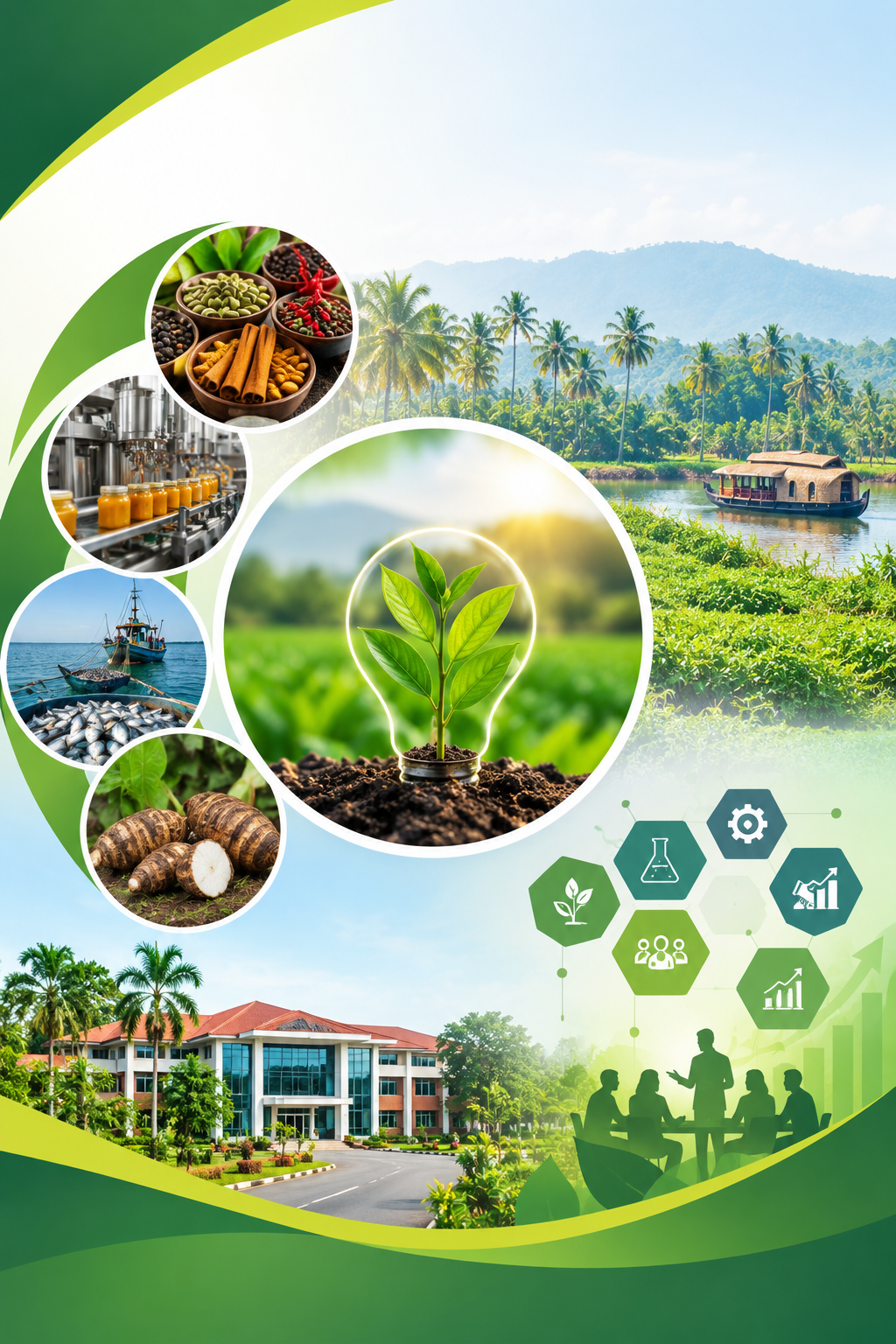
Agri-business incubators have become prominent instruments for converting agricultural research, processing technologies and entrepreneurial ideas into commercial ventures, yet the effectiveness of incubation depends on more than the existence of facilities or training programmes. Kerala provides an analytically useful setting because its support architecture is distributed across Kerala Agricultural University and commodity-specialised Indian Council of Agricultural Research institutes serving food processing, spices, plantation crops, fisheries and tropical tuber crops. This critical narrative review examines how these incubators support agri-entrepreneurship, the pathways through which support may affect venture development, the quality of available outcome evidence and the priorities for more defensible evaluation. Literature and institutional evidence published from 2003 to 21 June 2026 were identified through open scholarly indexes, regional repositories, citation searching and official institutional sources, with earlier foundational incubation research retained where conceptually necessary. The synthesis indicates that Kerala’s incubators offer a progressively broader bundle of physical infrastructure, technology transfer, product development, training, mentoring, grant or credit facilitation, intellectual-property support and market linkage. Their commodity specialisation creates strong potential for matching scientific capabilities to value-chain constraints, while stage-differentiated programmes and satellite incubation extend support beyond conventional facility-based models. Direct Kerala evidence, however, remains narrow. Existing peer-reviewed studies are small, retrospective or cross-sectional, focus mainly on surviving or graduated enterprises, and generally lack credible non-incubated comparison groups. Consequently, observed commercialisation, technology adoption or profitability among supported firms cannot be attributed confidently to incubation itself. Wider incubation research supports a small positive average association with venture performance but also shows substantial heterogeneity by programme design, specialisation, sponsorship, service utilisation, venture stage and regional context. Kerala’s policy challenge is therefore not simply to expand incubation activity, but to demonstrate additionality. Longitudinal cohort tracking, matched counterfactual evaluation, service-use measurement, post-graduation follow-up and outcome frameworks linking venture performance with farmer, value-chain and inclusion effects are required to establish which forms of agri-business incubation create durable public value.
Keywords: Agripreneurship; agri-business incubation; Kerala; technology commercialisation; agri-startups; entrepreneurial ecosystem; venture support; rural innovation.
Read Full Article: here